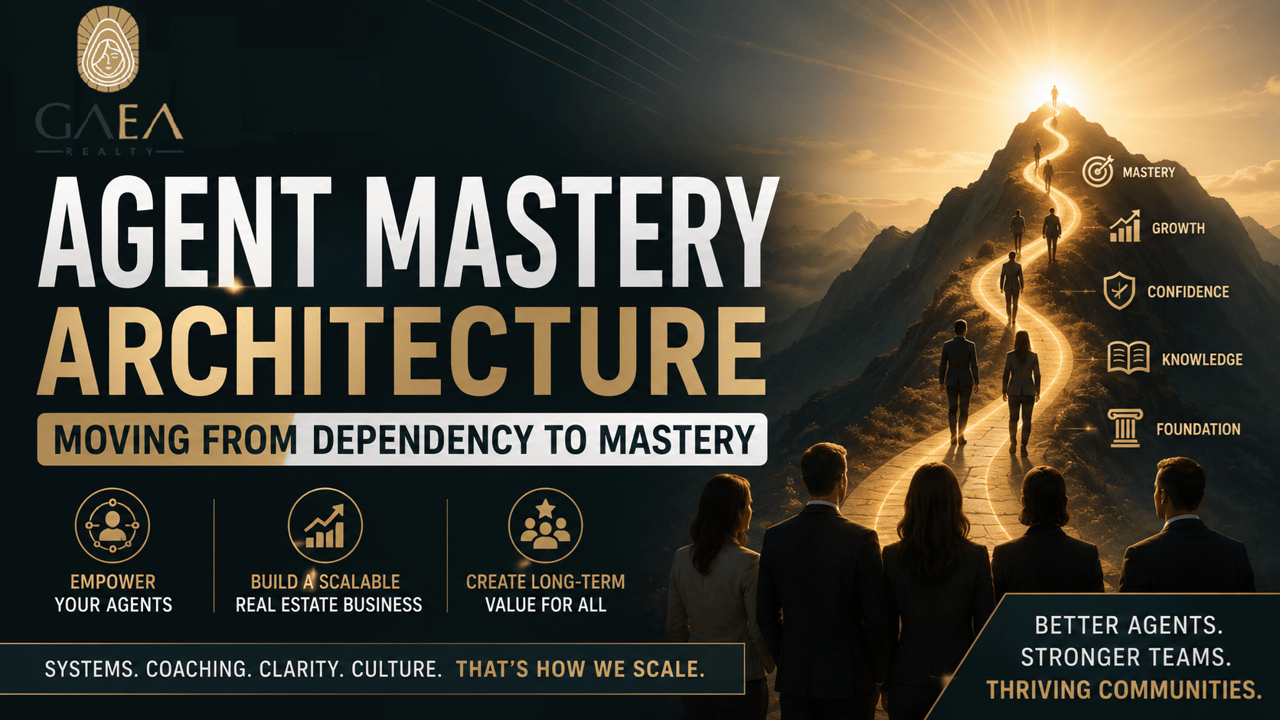
Why Real Estate Teams Fail
Real Estate Leadership Sean Chen May 23, 2026
Real Estate Leadership Sean Chen May 23, 2026
A lot of real estate teams are built on one dangerous sentence:
"You do not need to understand everything. Just do what I do."
That sentence usually comes from a successful team leader. They are a big producer. They close deals. They know the scripts, the neighborhoods, the objections, the lenders, the inspectors, the listing appointments, the emotional temperature of a buyer, and the pressure points of a seller.
So the team assumes success can be copied.
But that is exactly where many real estate teams start to fail.
A top producer can be excellent at selling real estate and still be poor at building people. Those are different games.
Real estate teams can work. In fact, they often work very well. NAR's 2018 Teams Survey found that 26% of respondents were members of a real estate team, with the median team size at four people. RISMedia also reported that four in five agents on teams said being on a team made them more productive and successful.
So the argument is not that teams are bad.
The argument is that teams fail when they are built around dependency instead of development.
A team should make agents smarter, faster, more supported, and more accountable. But many teams become personality-driven machines where every agent is expected to imitate the rainmaker without understanding the reasoning behind the rainmaker's decisions.
That creates fragile agents.
They can repeat the script, but they cannot diagnose the situation. They can follow the checklist, but they cannot explain the strategy. They can shadow the leader, but they cannot become trusted advisors.
And eventually the team hits a ceiling.
The top producer trap happens when a team leader believes personal success automatically qualifies them to lead, train, and scale others.
HousingWire described this exact issue: many real estate team leaders are successful agents themselves, but they often lack the leadership and coaching skills needed to develop other agents. The article also notes that some leaders focus on immediate transactions instead of long-term agent development.
That is the heart of the failure.
The leader says, "Do what I do," because that is how they succeeded. But newer agents do not have the same confidence, experience, market memory, client database, or pattern recognition.
The leader is playing chess from instinct. The new agent is still learning what the pieces do.
When the leader refuses to explain the why, the agent becomes dependent. They wait for instructions. They fear mistakes. They hide confusion. They bring every hard conversation back to the leader.
Now the team leader becomes the bottleneck.
The team grows in headcount but not in capability.
Consider the Kraig Thompson Team, a fictionalized Bay Area case study that reflects a pattern many agents will recognize.
In the Bay Area, where buyers are stretched, sellers are anxious, and every neighborhood can feel like its own separate economy, the Kraig Thompson Team looked unstoppable.
Kraig was the classic high-producing team leader. He knew Fremont, Oakland, San Jose, Walnut Creek, and the Peninsula like a map in his head. He could walk into a listing appointment and read the seller in five minutes. He knew when to push price, when to recommend prep, when to warn a buyer away from a bad inspection, and when to tell a client the truth even if it cost him the deal.
That was why people joined him.
At first, the team thrived. Agents got leads. They got Kraig's scripts. They got his reputation. They got to sit in on calls and watch how a real rainmaker handled pressure.
But the team had one hidden weakness: Kraig did not teach the thinking behind the moves.
His message was simple: "You do not need to understand everything. Just do what I do."
For a while, that worked. In a hot market, imitation can look like training. When homes sell quickly and leads are flowing, weak systems stay hidden.
Then the market got more complicated. Affordability tightened. Buyers became more cautious. Sellers still wanted yesterday's prices. According to the California Association of REALTORS, only 23% of San Francisco Bay Area households could afford the median-priced single-family home in the fourth quarter of 2025, with a median price of about $1.26 million.
In that kind of market, agents cannot survive on scripts alone. They need judgment.
That is where the team started to fall apart.
Agents could repeat Kraig's words, but they could not explain the strategy. They could open doors, but they could not advise. They could call leads, but they could not create trust. When clients asked hard questions about pricing, risk, concessions, interest rates, inspections, or timing, newer agents froze or ran everything back through Kraig.
Kraig became the bottleneck.
The team had production, but it did not have independence. It had activity, but it did not have mastery. It had a leader everyone followed, but not a system everyone understood.
Eventually, resentment grew. Some agents felt they were giving up a split without receiving real development. Others felt lead distribution was unclear. The strongest agents left to build their own business. The newer agents stayed dependent. The team that once looked like a machine became a group of people waiting for one person to think for them.
That is how many real estate teams fail.
Not because the leader is bad at real estate.
Because the leader never turns personal talent into shared knowledge.
Real estate is not a factory job. Every transaction has variation: financing, inspection results, emotions, timelines, appraisal risk, competing offers, seller motivation, buyer fear, local market shifts, and legal or compliance requirements.
Agents need judgment.
Google's research on high-performing teams found that two major drivers of effectiveness are psychological safety and structure and clarity. Psychological safety means people can ask questions and take risks without fear. Structure and clarity means people understand expectations, processes, and consequences.
"Just do what I do" fails both tests.
It discourages questions, which kills psychological safety. It also creates unclear structure, because the system exists inside the leader's head.
That is why agents on weak teams often feel busy but not better. They attend meetings, copy scripts, chase leads, and sit in accountability sessions, but they do not become more capable.
They are being managed for activity, not trained for mastery.
RISMedia's 2025 article on why agents leave team leaders points to lack of support and training, unfair lead distribution, poor transparency, and compensation that does not feel matched to value.
That makes sense. Agents will tolerate a lower split if the team gives them real leverage: leads, training, admin support, brand power, systems, coaching, and a path to higher skill.
But if the team only offers proximity to a producer, resentment builds.
The agent eventually asks: What am I actually learning here?
If the answer is "how to depend on the leader," the team is failing.
A real estate team has to play a two-balanced game.
First, it must produce now. Deals matter. Leads matter. Speed to lead matters. Follow-up matters. Listings matter. Revenue matters.
Second, it must develop future capacity. Agents need to understand pricing, negotiation, buyer consultation, listing strategy, scripts, objection handling, ethics, CRM discipline, client experience, and market interpretation.
Most failing teams overplay the first game and neglect the second.
They chase production so hard that they never build the people who could create sustainable production later.
That creates a cycle:
· The leader produces.
· The team depends.
· The leader gets overwhelmed.
· Training becomes rushed.
· Agents stay weak.
· The leader produces even more.
· The team never scales.
That is not a team. That is a top producer with helpers.
In real estate, whoever provides the best advice for free wins the game.
Not the loudest agent. Not the agent with the flashiest logo. Not the team with the most "just listed" posts.
The winner is the person or team that teaches the market before asking for the sale.
Buyers and sellers are overwhelmed. They do not just need access to listings. They need interpretation. They need someone who can explain what is happening, what matters, what is risky, and what move makes sense.
That is why the best teams give away real value before the client ever signs anything:
· Market breakdowns
· Pricing education
· Neighborhood guidance
· Buyer strategy
· Seller prep advice
· Inspection red flags
· Negotiation context
· Honest warnings
Free advice builds trust. Trust creates conversations. Conversations create clients.
The solution is not to remove the rainmaker. The solution is to turn the rainmaker's instincts into a teachable operating system.
A strong real estate team needs five things:
1. A written playbook. Every repeated task should have a documented process: lead response, buyer consultation, listing prep, showing follow-up, price reduction conversation, inspection negotiation, appraisal issue, closing week, and post-close referral request.
2. The why behind the script. Scripts are useful, but only when agents understand the psychology behind them. The goal is not memorization. The goal is judgment.
3. Coaching, not command and control. Harvard Business School Working Knowledge notes that strong sales leadership depends heavily on coaching and performance reviews, and that these are teachable management skills. The best leaders do not just close deals. They build people who can close deals.
4. Clear scoreboards. Track the behaviors that create business: conversations, appointments set, signed agreements, active pipeline, follow-up speed, database touches, listing appointments, and conversion by lead source. Do not just yell "work harder." Show agents where the business is leaking.
5. A culture where questions are allowed. If agents are afraid to say "I do not understand," the team is already broken. Confusion hidden early becomes expensive later.
This is where Gaea is striving to play a different game.
Gaea is not striving to build a team where one rainmaker wins and everyone else follows blindly. Gaea is striving to have everyone thrive: agents, clients, buyers, sellers, and the communities they serve.
That means building a culture where knowledge is shared, advice is generous, and every agent is trained to think, not just repeat.
In the Bay Area, the future does not belong to the team that hoards knowledge.
It belongs to the team that gives the best guidance away, earns trust at scale, and helps everyone get better.
Real estate teams fail when the leader confuses being followed with being effective.
A top producer can attract agents. But only a real leader can develop them.
The strongest teams do not say, "You do not need to understand anything."
They say:
"Watch what I do. Ask why I did it. Try it. Review the result. Improve it. Then teach it to the next person."
That is how a team stops being a personality cult around one producer and becomes a business that can actually scale.
|
Source |
Use in Argument |
|
NAR 2018 Teams Survey |
Team model context: team participation, size, and structure. |
|
RISMedia 2023 Real Estate Teams Outlook |
Evidence that many agents say teams improve productivity and success. |
|
HousingWire on team leaders and agent development |
Supports the top-producer trap and leadership-development gap. |
|
Google re:Work on team effectiveness |
Supports psychological safety, structure, and clarity as team-performance factors. |
|
Harvard Business School Working Knowledge on sales leadership |
Supports coaching and performance review as teachable leadership skills. |
|
RISMedia on why agents leave team leaders |
Supports failure causes: training, support, fairness, transparency, and value. |
|
California Association of REALTORS Q4 2025 Housing Affordability Report |
Sets Bay Area market context and affordability pressure. |
Stay up to date on the latest real estate trends.
Agent Growth
Sean Chen on Building a Successful Bay Area Real Estate Brokerage

Agent Growth
“When information becomes abundant, interpretation becomes premium.”

Agent Growth
Why Homeowners Ignore Most Agents (And How Top Producers Break Through)

Agent Growth
Redefining Sales Through the Art of Inquiry

BayAreaReal Estate
8 Traits of Top Real Estate Agents Worth Studying
Real Estate Leadership
How top-producer dependency breaks teams, and how Gaea can build a teaching culture where everyone thrives
Agent Growth
A thoughtful conversation on real estate decisions, AI careers, job security, investing, family, and what truly matters in life
Agent Growth
Chen Ran’s 3-Step Methodology
Agent Growth
If You’re a Real Estate Agent, Watch This Before You Quit